Abstract
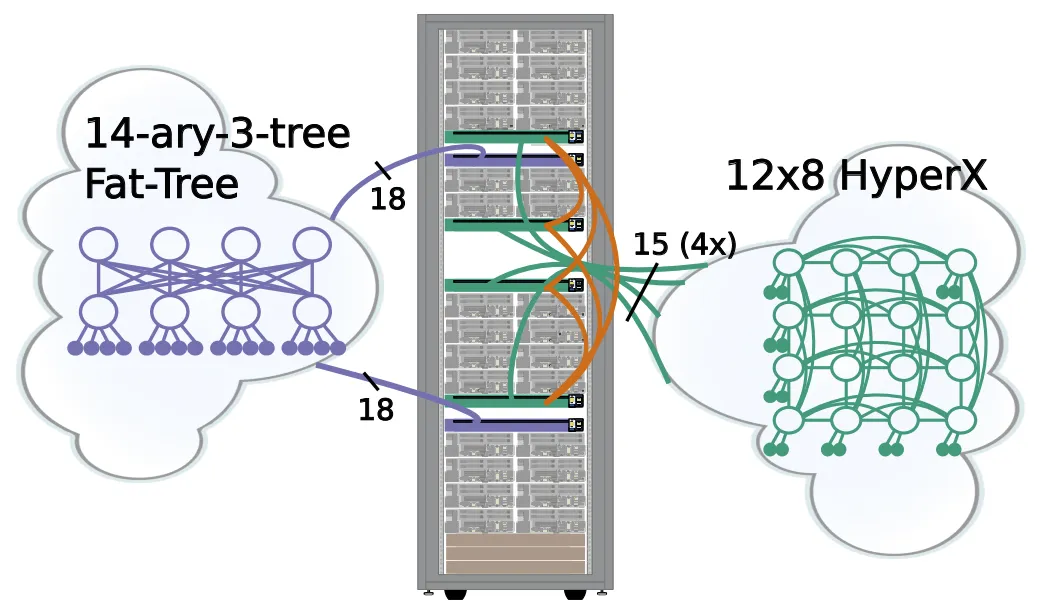
The de-facto standard topology for modern HPC systems and data-centers are Folded Clos networks, commonly known as Fat-Trees. The number of network endpoints in these systems is steadily increasing. The switch radix increase is not keeping up, forcing an increased path length in these multi-level trees that will limit gains for latency-sensitive applications. Additionally, today's Fat-Trees force the extensive use of active optical cables which carries a prohibitive cost-structure at scale. To tackle these issues, researchers proposed various low-diameter topologies, such as Dragonfly. Another novel, but only theoretically studied, option is the HyperX. We built the world's first 3 Pflop/s supercomputer with two separate networks, a 3-level Fat-Tree and a 12x8 HyperX. This dual-plane system allows us to perform a side-by-side comparison using a broad set of benchmarks. We show that the HyperX, together with our novel communication pattern-aware routing, can challenge the performance of, or even outperform, traditional Fat-Trees.
| Type | Conference paper |
|---|---|
| Publication | In The International Conference for High Performance Computing, Networking, Storage, and Analysis 2019 |
| Publication (short) | In SC19 |
| DOI | 10.1145/3295500.3356140 |